Thursday, March 31, 2011

10 Ways to Get Your Marriage Back on Track


By Kimberly Dawn Neumann


First comes love, then comes marriage, then comes happily ever after. End of story, right? Not quite… While it’s true that couples relax a bit after they think they’ve nabbed the matrimonial Holy Grail, the reality is that they may also find themselves dumbfounded if their fairytale starts slipping away. “Many people think that marriage is about marrying the right person, so when things go wrong, they automatically go to the ‘Crap, I accidentally married the wrong person’ place,” says Alisa Bowman, author of Project: Happily Ever After. “Although you do want to marry someone you are basically compatible with, marriage has a lot less to do with marrying the right person than it has to do with doing the right things with the person you married.” In other words, relationships are a constant work in progress. To keep the happy connection that made you say “I do” in the first place—or maybe even create a newer-and-improved version—try out these 10 tips to rehab your romance. 1. Nurture yourself.
Marriage is about giving, but don’t make the mistake of giving too much. “To have a good marriage, you need to be a good you,” says Bowman. “Learn how to prioritize and put boundaries around activities that keep you healthy and whole—activities like rest, relaxation, fitness and time with friends.” In other words, remember that scheduling “me” time into your day is not selfish, it’s a necessity. It will strengthen your relationship because you’ll have a saner version of “you” to bring to the “us” equation.
2. Define your problems.
Spend some time looking at your relationship and figure out which parts work and which parts don’t. Bowman suggests that you take a moment to imagine a perfect day in your perfect relationship. What would this look like? How would you and your partner interact? Then create a plan of how you might get from point A (your current reality) to point B (that perfect day). Write it down if you need to, then start breaking the issues into bite-size pieces and tackling them one at a time. Before you know it, there will only be a few bite-size problems left.
3. Make a financial plan together.
Money is one of the biggest stressors in a marriage. Couples worry and argue about it constantly. If you find you and your spouse are starting to badger each other over the bottom line, it’s time to have a penny-pinching powwow. “We are all guilty of something economists call ‘passive decision-making,’ which just means defaulting to the easy option,” says Jenny Anderson, coauthor of Spousonomics: Using Economics to Master Love, Marriage, and Dirty Dishes. “Couples need to make an active plan about how they will manage their money: Combine it? Separate it? Create a joint account and keep some separate? Whatever the decision, both people have to be part of the decision to do it and then figure out what needs to be done to keep the system humming.”
4. Use the three-sentence rule.
When you need to ask your partner for something that could be misconstrued as nagging, keep the request at three sentences—max. “The art of being assertive without coming off as aggressive lies in being succinct and using a warm tone of voice and body language,” says Bowman. “When you keep your requests to three sentences or fewer, it’s almost impossible to blame, use sarcasm or use put-downs.” It’s also a lot more likely that you’ll get your point across without losing your spouse’s attention. Make your request with a smile. Be sincere and encouraging. You might even rest your hand on his thigh as you say, “Honey, the house is a mess and I am exhausted. Could you help me clean this place up? I could really use your help.”
5. Take your fighting gloves off.
Don’t duke it out. Instead, consider taking a time-out. “There's a concept called 'loss aversion' in economics, which simply means we really hate to lose. And when we think we are losing, we fight like there is no tomorrow to try to win,” says Anderson. “It happens when couples talk about hot-button issues like sex, housework, money or the kids. If either person thinks he or she is losing, he or she will ratchet up the stakes and escalate the issue.” The next time you see a spousal spat going to a not-so-happy place, take a break and revisit the subject when neither one of you feels overwhelmed by the topic.
6. Just do it.
Yes, by “do it” we mean have sex. Intimacy is an important part of a vital relationship, and one of the first areas to suffer if feelings are floundering. But sexual encounters can also be one of the quickest ways to reconnect and rekindle with your partner. “Of the many forms of couple intimacy—a smile across a room, a kiss, a touch—sex has the potential to be the most powerful positive physical experience most of us enjoy,” says Joel D. Block, PhD, coauthor of Sex Comes First: 15 Ways to Save Your Relationship…Without Leaving Your Bedroom. “This is especially true if sex results in emotional fulfillment, better communication, security and reassurance."
Make your sex life a priority by following these five tips. 7. Burn your grudges.
It’s time to set some bad memories on fire. Literally. Sometimes hanging on to those “Do you remember the time you did such and such?” moments are the things that lead to relationship sabotage. Instead of carrying grudges around forever, torch them. “Write them all down on a piece of paper. Then set a timer for a certain amount of time. It might be 10 minutes. It might be 30. It might be the whole day. The point is: Give yourself as long as you need to really wallow in the misery of these grudges. Savor them. Get angry about them. Mutter about them. Do whatever you need to do to get sick and tired of them,” says Bowman. “Once you are done, say, ‘I will not think about these anymore. These grudges have lost their usefulness.’” Then take a match and burn them.
8. Don’t be overly confident.
Overconfidence can lead to complacency, which is not good for any relationship. According to Anderson, in a survey published in August 1993 in the journal Law and Human Behavior, couples who had recently applied for a marriage license were asked to estimate the average rate of divorce. Almost uniformly, they accurately predicted about 50 percent. Then they were asked to estimate the chances that they would get divorced. They answered zero percent. The problem with this statistic is that, if there is no perceived risk of failure, no “work” is put into maintaining the relationship—until it’s suddenly faltering. Don’t let yourself gloss over the little things. Don’t forget to make an effort to keep your romance alive. Don’t find yourself in a situation where you realize that you could have done more…when it’s already too late.
9. Write your spouse’s eulogy.
This one isn’t as macabre as it sounds. It’s more of an exercise in appreciation. Bowman suggests that you work on it a little at a time as a way to notice what your spouse does right (since these are the things you’d likely eulogize him with, not the negatives). “Think back over the years you’ve known this man. When did he make you laugh? When did he make you cry tears of joy? When did he surprise you? When did he feed the cat because the smell of cat food makes you want to hurl? Put it in the eulogy,” says Bowman. “The funeral fantasy will help you remember to appreciate your spouse.”
10. Remind yourself you have a choice to stay married.
Many people stay in troubled marriages because they believe they have no other choice. “They think that they are stuck, and they blame this sensation of being stuck on their spouse. But if you are stuck, it’s your fault and not your spouse’s,” says Bowman. That fact is, “you are not stuck; you have choices. Three of them: Do nothing and remain miserable; face your fears and try to save your marriage; ask for a divorce.” Choose to either be married or not. Make a choice. And wake up every morning and make that choice again. The surest path to happiness is knowing that you are not a helpless damsel in distress, but rather a woman who can make her own decisions. You have the choice to live happily ever after.


Original article appeared on WomansDay.com

Related links on WomansDay.com:
Getting Past the Same Old Fights

10 Marriage Rules You Should Break

How to Talk to Your Husband About Sex
View and submit comments about this post »

Wednesday, March 23, 2011

Power to the pocket: The next generation of superphones


By Nick Mokey, DigitalTrends.com
These up-and-comers from the smartphone world will redefine the boundaries of mobile computing with full HD video playback, dual-core processors, and more.
The next generation of superphones
We’re sick of the iPhone, too. Despite antenna issues, Draconian app store rules and an engineered inability to run Flash content, Apple’s flagship smartphone has done to the smartphone market what the Romans once did to Europe.
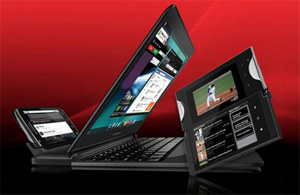
The good news: Now a marauding horde of smartphone manufacturers under the flag of Google Android are back for their turf, and they’re not just cobbling together iPhone-wannabes anymore. From the world’s first dual-screen smartphone to a phone with all the processing power of a laptop – and a dock that turns it into one – these next-generation smartphones will all bring something totally unique to the battlefield when they arrive soon.

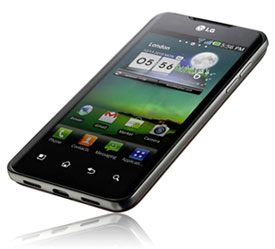
LG Optimus 3D
LG Optimus 3D
More from DigitalTrends.com

LG Optimus 3D

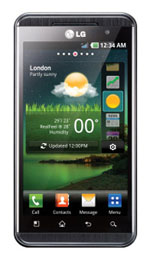
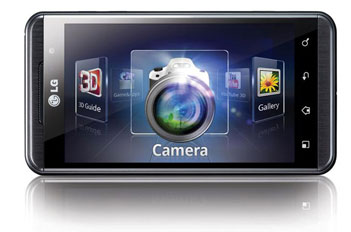
The pitch: The 3D craze that has been raging on televisions for the last year finally reaches the small screen with the world’s first 3D smartphone. No glasses needed, just gaze into the 4.3-inch LCD and 3D content comes to life. As if that weren’t enough, dual 5-megapixel cameras in the rear allow you to capture 3D video in 1080p, for playback right on the phone, or a 3D TV via HDMI.
Skeptic’s slant: 3D seems questionable enough on a television, on a phone it’s almost comically frivolous. Adding depth to a screen you have to touch could actually make the phone harder to use, and experience also tells us that viewing 3D content on a screen this small typically lacks the punch that has made 3D a hot seller in theaters.
Availability: LG announced the Optimus 3D at Mobile World Congress in February; both price and availability are TBD.
LG Optimus 3D
LG Optimus 3D
Motorola Atrix 4G
Motorola Atrix 4G

Motorola Atrix 4G

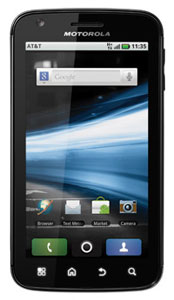
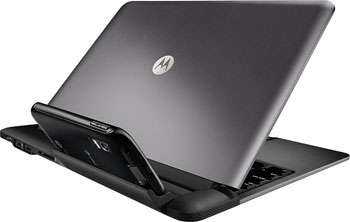
The pitch: Plug Motorola’s Atrix 4G into its optional dock and the humble smartphone becomes a 13-inch notebook, giving you a full-size screen, keyboard, and even a separate battery to charge the phone as it sits.
Skeptic’s slant: The optional laptop dock will cost you $500, and because it doesn’t run Windows 7, it does a lot less than a $350 netbook would.
Availability: AT&T is currently selling the Atrix 4G for $199 with a two-year contract.


LG Optimus 3D
Motorola Atrix 4G
Kyocera Echo
Kyocera Echo

Kyocera Echo

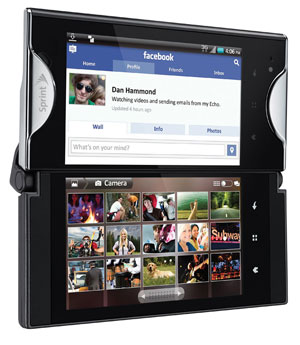
The pitch: When the Echo’s little 3.5-inch touchscreen starts to feel a little cramped, slide it apart and a second identical screen rises up to meet it, providing a combined 4.7 inches of glowing LCD. The two screens allow you to browse side-by-side websites, read an e-mail in one screen while you reply in another, and even play games like The Sims where one screen acts as a controller, similar to the Nintendo DS.
Skeptic’s slant: Not many apps will work with the dual-screen functionality right off the bat, and running two screens at once will cost you big time on battery life.
Availability: Sprint offers the Echo for $199 with contract, but it won’t begin shipping until sometime later in spring.
Kyocera Echo
Kyocera Echo
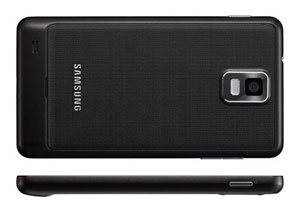
Samsung Infuse 4G
Samsung Infuse 4G

Samsung Infuse 4G

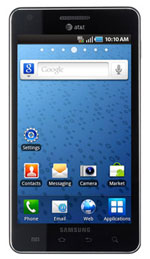
The pitch: With a whopping 4.5-inch Super AMOLED Plus Screen and a body as deep as a pencil, the Infuse 4G will be both the largest and thinnest phone in AT&T’s portfolio. Thanks to HSPA+ 4G, it will also be one of the fastest on the network. And did we mention it shoots 1080p video?
Skeptic’s slant: Sprint’s 4.3-inch EVO 4G already dropped jaws (and stretched pockets) with its screen size. Is a 4.5-inch screen on a phone really practical?
Availability: Samsung’s Infuse 4G will arrive in the second quarter of 2011 exclusively on AT&T.


Samsung Infuse 4G
Samsung Infuse 4G
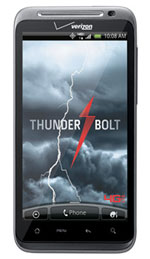
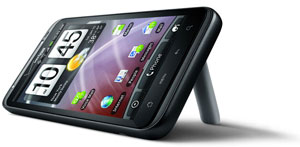
HTC ThunderBolt
HTC ThunderBolt

HTC ThunderBolt

The pitch: Verizon’s first 4G LTE handset will also be the first to support Skype-to-Skype video – with or without Wi-Fi. No more clambering around to find a hotspot when you want to videoconference, and being limited to friends with Facetime. It packs the same jumbo-sized 4.3-inch LCD and 8-megapixel camera as Sprint’s EVO 4G.
Skeptic’s slant: It’s warmed-over EVO 4G on Verizon. On second thought, maybe that’s not such a bad thing after all.
Availability: The ThunderBolt is available with Verizon Wireless, priced at $249.99 with a 2-Year contract.
HTC ThunderBolt
HTC ThunderBolt
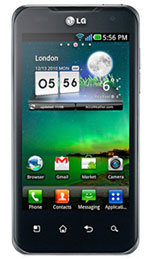
LG Optimus 2x
LG Optimus 2x

LG Optimus 2x

The pitch: Two is always better than one, which makes the LG Optimus 2x, the world’s first dual-core smartphone, quite a catch. Nvidia’s hotrod Tegra 2 processor enables rich gaming, fluid multitasking and even 1080p video capture. With the HDMI output, you can hook it up to your TV and watch movies on the big screen, in 1080p.
Skeptic’s slant: Apps have to be specially developed to take advantage of the dual-core design, which means few of them will really tap into what the Optimus 2x can do at launch.
Availability: Rumors have the Optimus 2x launching in late March or early April, but LG will launch the Optimus 2x as a “world phone.” That means it won’t be showing up at the store down the street with a hefty subsidy like phones that carriers officially adopt – you’ll have to snag it online, without a contract, for a hefty sum.
LG Optimus 2x
LG Optimus 2x
Follow Yahoo! Shopping on and become a fan on
AdChoices
<SCRIPT language='JavaScript1.1' src="http://ad.doubleclick.net/adj/N4359.yahoo.comOX2562/B5091231.12;abr=!ie;sz=300x250;click=http://global.ard.yahoo.com/SIG=15uoskbsa/M=601186519.601669786.548412551.548412551/D=shp/S=784731229:LREC/_ylt=Ash7aHB0aZOB0yhFEjxgXmtdDMYu/Y=YAHOO/EXP=1300894071/L=Lneb62KJ30k1ZoU9SYdT0Qo7qusAdU2J9VcAAsBM/B=g.TEU2KImiE-/J=1300886871226967/K=V.3mAeaQTToeXTpJE6D0Ew/A=2355413971662359482/R=2/X=3/*;dcopt=rcl;mtfIFPath=nofile;ord=1300886871226967"></SCRIPT><NOSCRIPT><A HREF="http://global.ard.yahoo.com/SIG=15uoskbsa/M=601186519.601669786.548412551.548412551/D=shp/S=784731229:LREC/_ylt=Ash7aHB0aZOB0yhFEjxgXmtdDMYu/Y=YAHOO/EXP=1300894071/L=Lneb62KJ30k1ZoU9SYdT0Qo7qusAdU2J9VcAAsBM/B=g.TEU2KImiE-/J=1300886871226967/K=V.3mAeaQTToeXTpJE6D0Ew/A=2355413971662359482/R=0/X=3/SIG=13lrjqj86/*http://ad.doubleclick.net/jump/N4359.yahoo.comOX2562/B5091231.12;abr=!ie4;abr=!ie5;sz=300x250;ord=1300886871226967?"><IMG SRC="http://ad.doubleclick.net/ad/N4359.yahoo.comOX2562/B5091231.12;abr=!ie4;abr=!ie5;sz=300x250;ord=1300886871226967?" BORDER=0 WIDTH=300 HEIGHT=250 ALT="Advertisement"></A></NOSCRIPT>
AdChoices

Top-Ranked Cell Phones

Tell Us What You Think

Have you made a financial contribution to aid Japan?

Tell Us What You Think

Have you made a financial contribution to aid Japan?

  • Yes
    %
  • I plan to.
    %
  • No.
    %
  • I will to donate through other means.
    %
(0 people voted in this poll)
AdChoices

Related Articles

8 Steps to Get Your Financial Life in Order


More from

Do you have "frugal fatigue?" You're not alone. Pinching pennies becomes exhausting, year after year. You dream of breaking free and buying everything in sight.
But tiresome as budgets are, consumers haven't quit them yet. You threw some money around in December, when credit card use bumped up for the first time since the 2008 financial collapse. Then remorse set in. Consumers slashed their credit-card spending in January by 6.4 percent at an annualized rate, the Federal Reserve reported this week.
That fits with what the National Foundation for Credit Counseling is seeing on the ground. In a recent NFCC survey, two-thirds of consumers said that they're sick of having to question every dollar they spend, but have no choice. Incomes are virtually flat, employers aren't calling the long-term jobless back to work, and the cost of critical purchases such as health insurance and gasoline are leaping up. Only 5 percent of the people questioned said that they couldn't stand to keep living under fiscal restraint, and intended to spend more. About 8 percent said they didn't need to be particularly frugal. They hadn't cut spending and were doing fine.
The rest -- about 20 percent of the consumers -- overcame their frugality stress in the old fashioned way: they changed their lifestyles so they could live comfortably within the incomes they had. They found this new life so positive that they said they'd never go back, reports Gail Cunningham, a spokesperson for NFCC.
If you're sure that your financial troubles are temporary, it pays to pinch the pennies until the dollars start rolling back in. But the story is different if you see little hope of raising your income by enough to make your current expenses each to cover. Emotionally, making big changes is hard to do. But the faster you reinvent your life, the more money you'll have in your pocket and the sooner you'll be able to save again.
Your two largest expenses are probably your home and your consumer debt (plus health insurance, if you're not on a company plan). Your first step is to quit adding to debt -- put your credit cards on deep freeze and pay bills with cash or a debit card. Then follow these steps:
1. If you live in an apartment, check comparable rents in your neighborhood.
They've dropped in many parts of the country. If you find that you're paying more than the market requires, show your landlord proof and ask for a rent reduction. If the answer is no, move.
2. If you own a home and it's salable, sell.
Put any net gain into savings and investments, and find an apartment to rent. You'll be saving the high cost of maintaining a house, as well as tax and insurance bills.
Don't hold onto a house because you think you "need" the mortgage interest deduction. Financially, you're far better off without it. As an example, say that you're paying $1,000 in interest, in the 25 percent tax bracket. The taxpayers cover $250, leaving $750 as your net cost. Now imagine that you have no mortgage and $1,000 in income. You'll pay $250 in taxes, leaving you with $750 in your checking account. Losing the mortgage gives you more money to spend.
3. Restructure your credit card debt.
Move some of it to a new card with a zero-rate promotional offer. Don't use that card for purchases right away. Instead, concentrate on repaying this debt within the promotional period. You might also move debt from a high-rate card to one that's charging a lower rate.
4. Start a debt-repayment avalanche.
Get the latest bill for each of your credit cards, to see which one is charging you the highest rate (some cards have two rates, one higher than the other). Pay the minimum on the lower-rate cards and put all the rest of the money toward knocking off the high-rate debt. When that card is clean, move on to the next one.
Some people prefer to start by repaying the card with the smallest debt, even if its interest rate is low, for the pure pleasure of eliminating an annoying bill. Do whatever works. But you'll get the most bang for the buck by tackling the high-rate card first.
5. If you have savings, put all but a token amount against credit card debt.
Keep only $500 or $1,000 for unforeseen expenses. Consumers often don't realize the enormous return on investment they get from cleaning up their credit cards. For example, say that you're paying interest at a rate of 18 percent. Every payment you make against that debt gives you a guaranteed 18 percent return on your money. If you're paying a penalty interest rate of 24 percent, every payment equals a 24 percent investment gain. Where else could you get a yield like that, and totally safe?
6. If you have money in a 401(k) retirement plan and your job is safe, consider borrowing against it.
In theory, I consider these plans inviolable -- never to be touched. In practice, it makes sense to use them if they can help you rightsize your life. The transaction will look like this:
You'll borrow from the plan at 1 to 3 percentage points over the bank prime rate, which is currently 3.25 percent. So the loan might cost you 5.25 percent. You'll repay credit card debt at 18.25 percent, for a 13 percent gain. Typically, you'll have to repay the 401(k) loan over five years, with the payments deducted from your paycheck automatically. The interest you pay goes right back into your account, so you're paying t to yourself.
There are two financial downsides. First, you're repaying the loan with after-tax dollars. When you eventually take money out of the 401(k), those dollars are taxed again. But you're probably still ahead, thanks to the savings on your credit card bills. Second, you'll lose any appreciation that would have accrued to the money you borrowed. You can minimize this risk, however, by arranging to borrow against only the bond portion of your plan, leaving the stock portion exposed to any gains.
If you leave your job, and part of the loan is still outstanding, you'll have to repay it right away, in full. If you can't, the remaining loan will be treated as a withdrawal. You'll own income taxes on the money and a 10 percent penalty if you're younger than 59 1/2. So this loan is for someone who is pretty sure that his or her job is safe.
7. If you're one of the lucky 78 percent of homeowners who have equity, you could -- potentially -- pay off your credit card debt with a new home equity loan.
But the argument isn't as compelling as it is for loans against 401(k)s. Ideally, you're aiming for a paid-up home when you retire. That will cut your cost of living, give you access to a reverse mortgage for extra cash, and provide money needed for long-term care. A home equity loan might make that impossible.
8. If you don't have health insurance, any major illness could put you into bankruptcy.
Try for a high-deductible policy, or see if you (or your kids) qualify for Medicaid or the children's program, Schip. If insurance companies won't take you because of a medical condition, try for a place in the high-risk pools set up by the new health reform act. We're a long way from equal access to medical care, let alone care at an affordable price. But if you cut other expenses, you just might be able to afford good health.
This article is part of a series related to being Financially Fit

Tuesday, March 15, 2011

First Person: I Saved Over $5,000 on My Last Car Purchase


yahoocontributornetwork
, On Wednesday March 9, 2011, 4:58 pm EST
*Note: This was written by a Yahoo! contributor. Do you have a personal finance story that you'd like to share? Sign up with the Yahoo! Contributor Network to start publishing your own finance articles.
Anyone who's ever been in the financing office of a car dealership knows that working through the purchase details on a new car is no fun whatsoever. The dealer is not only trying to make the money listed on the sticker price, but he's also trying to put a few bucks in his and the loan company's pocket as well. The thing that these retailers fear most is an educated and prepared consumer.
Here are four simple things that I did during my last car purchase that saved me over $5,000.
Research
Before I ever stepped foot on the salesman's turf, I pulled up the Internet and found out everything that I could about the make and model that I was going to purchase. I also looked up what private sellers were asking for the same vehicle that I was looking at. Using this knowledge, I set a firm budget for the car which just happened to be $1,400 less than the sticker price that the dealer listed. We ended up settling on a price that was $2,100 less than sticker price, and we got here because I never told him what my maximum budget number was. When he gave a price, I told him "too high."
Reading
When I sat down in the financing office to discuss the financing of the vehicle, I took the itemized listing of fees and made the loan processor define every single item that was listed. There were so many fees that were "administrative" in nature it would make your head spin. I argued every single cost that was listed that wasn't tax, tag or title related. The dealer was assessing me a whopping $600 in unnecessary administrative costs. I know that this seems very small when financing a $30,000 car, but would you carry $600 in unnecessary interest on your credit card for five years?
Perks
People have often told me that I go too far with this one, but I don't think so. In this economy, it is up to the consumer to stretch his or her dollar as far as possible and that's what I did here. First, never drive a car off the lot with anything less than a full tank of gas. At these gas prices, believe me it's worth it. Also, make sure that your car is perfectly detailed. Also, I got my dealer to agree to give me a free oil change every 5,000 miles for the first 50,000 miles. At $30 per oil change, this comes to a savings of approximately $300. He also agreed to give me my first vehicle inspection and standard maintenance care scheduled for that inspection for free. That's another $200 saved.
Financing
That's right. I haggled with the lending team at the dealer and got all of these perks agreed to in writing and then informed that I was going to use my bank for the financing. Yes, it did tick off the financing group. And yes, I had already figured I was going to do this before I even walked onto the car lot. I still wanted to hear what they were offering and I knew that during the financing negotiation I would learn all the fees they had lumped in and that this would be the best time to get the perks I wanted. My bank's lower rates saved me an additional $2,000 over the term of the 5-year loan.
More from this contributor:How to Save Big Money at the Gas Pump
Easy and Simple Ways to Get out of Debt
5 Easy Low Risk Ways to Fund a New Business
Contribute content like this. Start here.

Sunday, March 6, 2011

Cars that get 40 mpg: what buyers need to know


print
By KEN THOMAS, Associated Press
WASHINGTON – If you're worried about rising gasoline prices, you'll find plenty of options for fuel-efficient cars in 2011.

Nissan Leaf
Nissan Leaf
Five years ago, few vehicles got better than 30 miles on a gallon of gas, but vehicles that can get 40 mpg on the highway or in city driving are becoming more common, prompted by new government rules and advances in technology. Around 20 vehicles from the 2011 model year have reached this leading edge of efficiency, about triple the number in 2006, according to the Environmental Protection Agency.

Automakers are being forced to raise the efficiency of cars to meet tougher government standards. The average fuel efficiency of all new cars and trucks sold in 2016 will need to reach 35.5 mpg. That's about 40 percent higher than current standards, and requirements will only get stricter. Regulators are considering requirements that could reach 62 mpg by 2025.

WHAT'S AVAILABLE:

Cars getting 40 mpg or more include those with hybrid, electric and combustion engines with advanced technology. The cars are generally pricier than their gasoline counterparts. But paying more upfront could offset gasoline costs over the lifetime of the car, especially if pump prices keep rising.

Toyota Prius
Toyota Prius
Among hybrids, you'll find the Toyota Prius and Honda's Insight and Civic hybrids. Ford offers the Fusion and Lincoln MKZ hybrids. Hybrids use a conventional gasoline engine and a big battery to power the car.

The Civic hybrid starts at around $24,000 while the Prius costs around $23,000. By comparison, a basic Civic with a combustion engine starts around $16,000.

Diesel fuel is another option. Volkswagen makes diesel versions of its Golf, Jetta and Sportwagen. The small Golf starts at $23,000 — about $5,000 more than the gasoline version. The diesel wagon costs about $25,000.

Volkswagen Jetta SportWagen TDI
General Motors offers the Chevrolet Volt, which goes about 40 miles on battery power before it needs to be recharged with a backup gasoline engine. The engine can extend the car's range to 375 miles. Nissan is offering the Leaf, an all-electric car, which can travel 100 miles on battery power before it needs recharging.

The base sticker price for the Volt is $40,280 and the Leaf has a sticker price of $32,780. Both qualify for a $7,500 federal tax credit.

Several niche electric cars also beat the 40 mpg benchmark, such as the Tesla Roadster, but these are well out of reach of mainstream buyers. The Roadster costs $109,000. Tesla plans to sell a less expensive Model S next year for $49,900, including federal tax credits.

GAS PRICE WORRIES:

Automakers want cars they can sell to people concerned about pump prices, which are rising. They're averaging more than $3.19 a gallon — 53 cents higher than a year ago — and could climb to $4 if unrest in the Middle East continues to disrupt oil supplies.

In fact, the price of oil briefly hit $100 per barrel on Wednesday for the first time since Oct. 2008. Higher crude prices push up the cost of gasoline.

In 2008, when gasoline prices soared past $4 a gallon, many companies were caught off guard with truck-heavy lineups.

For consumers, the high-mileage vehicles offer upfront costs and long-term benefits.

David Friedman, research director for the clean vehicles program with the Union of Concerned Scientists, estimated that a consumer who moved from a vehicle that gets about 30 mpg on the highway to one that gets 40 mpg on the highway would save more than $4,000 over the life of the vehicle if gas cost $3 a gallon.

If gas rose to $4 a gallon, the savings would be even greater, about $6,000 over the car's lifetime.

HOW TECHNOLOGY HELPS:

Automakers boost fuel efficiency with a variety of technology — from turbochargers and diesel engines to batteries and materials such as aluminum, which lowers the weight of cars and trucks.

Turbochargers increase the power of the engine by pumping air into the combustion chamber at higher-than-normal pressure, creating higher power output.

Mercedes-Benz is planning to put "start-stop" technology on its vehicles, stopping the engine when the vehicle halts at a red light or in traffic and then restarting it when the driver hits the accelerator. Others are using lighter materials such as aluminum and high-strength steel, using more efficient tires and finding ways to improve aerodynamics.

GM's Chevrolet Cruze Eco, which exceeds 40 mpg on the highway, has a unique air shutter system behind the car's front grill. Sensors open and close the shutters automatically, depending on the vehicle's speed, to reduce wind drag.

Companies are also using fewer eight-cylinder and six-cylinder engines and have shifted some truck-based SUVs — such as the Jeep Grand Cherokee — to car-based crossovers, which don't use as much gas. The goal is to improve fuel efficiency but still attract families who want extra space.

Dave Westcott, who owns Buick-GMC and Suzuki dealerships in Burlington, N.C., notes that a 4-cylinder GMC Terrain crossover gets fuel efficiency ratings (23 mpg combined) that are comparable to some cars.

"People are used to convenience in size," he says. "If you have three kids and you have to take them to school, it's hard to get three car seats in the car."